
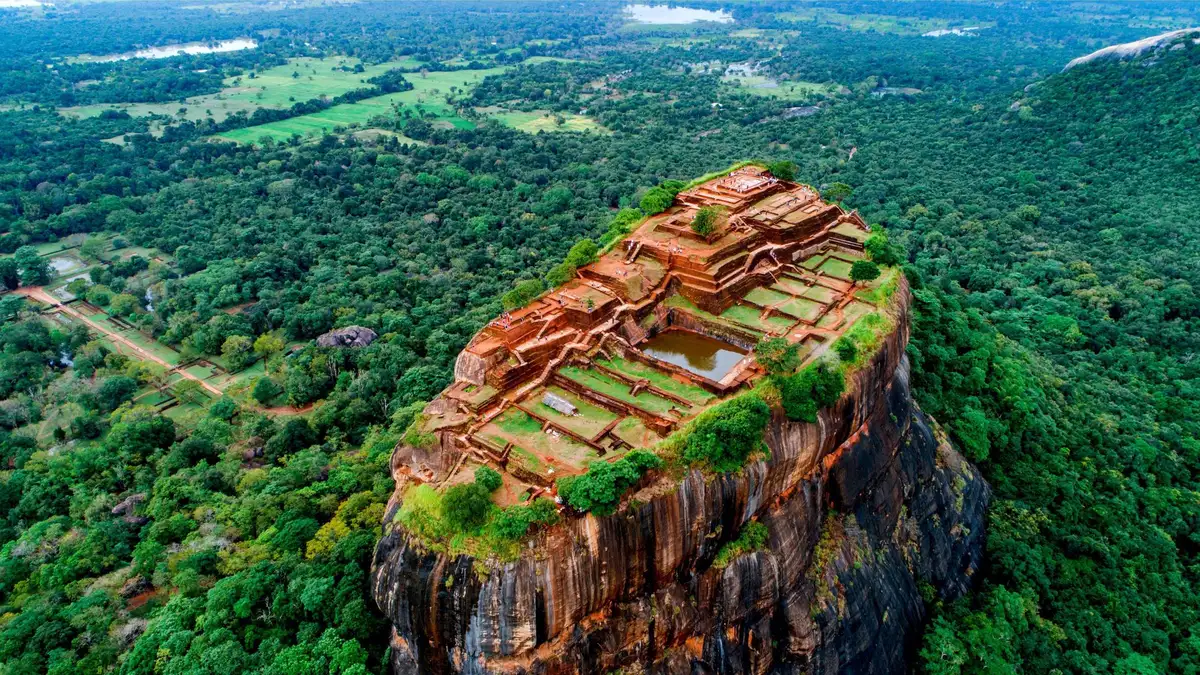
Visitor guide
Sigiriya Lion Rock: Complete Visitor Guide
A fifth-century palace on top of a 200 metre granite plug, reached by roughly 1,200 steps. Here is what it costs, how long it takes, what you will actually see on the way up, and how to climb it without spending the worst of the day in a queue.
At a glance
- Opening hours
- Ticket counters open 7:00 to 17:00
- Ticket price
- About USD 35 (check at the counter, prices change). About USD 20 for SAARC nationals, about half for ages 6 to 12.
- Time needed
- Two and a half to four hours for the whole site
- Best time to visit
- At opening, or after 15:00. Avoid 11:00 to 14:00.
- Getting there
- About 17 km from Dambulla, 170 km from Colombo
- Steps to the top
- Roughly 1,200, almost all of them staircases
The short version
Why there is a palace on top of a rock
In the late fifth century King Kasyapa moved the Sinhalese capital here and built a royal citadel on and around the rock. The traditional account is that he had seized the throne and feared his half-brother would come for it, so he chose somewhere that could not be approached unseen. After his death the site passed to Buddhist monks and faded as a seat of power.
What makes Sigiriya unusual is not the fortification but the approach, landscaped as a single composition: water gardens on the flat ground, then boulder gardens, then terraces, then the rock. You are meant to walk it in sequence, and the sequence still works. UNESCO inscribed the site in 1982.
On the way up
What you will actually see
- Water gardensSymmetrical pools, moats and gravity-fed fountains on the western approach. Some still run after heavy rain, which is roughly 1,500 years of plumbing still working.
- Boulder gardensHuge granite boulders with notches cut into them, where timber buildings were once pinned to the rock.
- The frescoesA sheltered gallery partway up, reached by a spiral staircase, holding painted figures of women in vivid ochre and green. Only a small fraction survive.
- The mirror wallA polished plaster wall, once reflective, covered in verses scratched by visitors between the sixth and fourteenth centuries. It is one of the oldest visitor books anywhere.
- The lion pawsTwo enormous carved paws flanking the final staircase. The stairway once passed through a lion's head, which is where the name comes from.
- The summitThe footprint of the palace: throne platforms, cisterns cut into the rock, a bathing pool, and a view across the forest to Pidurangala.
Step by step
How to climb it
- Buy the ticket before you arriveBook at eservices.ccf.gov.lk and you walk past the counter queue, which at opening time is often the longest wait of the day.
- Start at the western entranceIt takes you through the water gardens in the order they were designed to be seen. The northern entrance skips them.
- Pace the gardensGive the flat section half an hour. Hurry it and you reach the rock already hot.
- Take the fresco staircaseThe spiral stair is single file and bottlenecks, but the queue moves faster than it looks.
- Walk the mirror wall slowlyA narrow gallery with a drop on one side and no overtaking. Use it as a rest.
- The lion paws terraceThe last flat ground and the last shade. Drink here before the final stairway.
- The final stairwayOpen metal steps up the rock face: exposed, steep, and the part people find hardest. Use the landings.
- Come down the far sideThe descent route is separate, so you are not fighting traffic on the stairs.
Before you go
Heat, crowds and what to bring
What to bring
A refillable water bottle, more than you think. Sun protection, because almost none of the climb is shaded. Shoes with grip, since the stone steps polish smooth. A hat you can secure. Cash, if you have not booked online.
Heat and crowds
The rock faces the sun most of the day and the metal staircases radiate heat. Between roughly 11:00 and 14:00 the climb stops being enjoyable. The good windows are the first hour after the counters open and the last two before closing. Coaches tend to arrive mid-morning, so the early window is quieter as well as cooler.
Accessibility
The summit needs roughly 1,200 steps including open metal staircases with drops, so it is not accessible to wheelchair users or anyone who cannot manage sustained stairs, and there is no lift or alternative route. The water gardens and boulder gardens at the base are mostly flat compacted paths and are worth visiting on their own.
Travel plastic-free
Sigiriya is a UNESCO site and discarded bottles are a visible problem on the approach paths.
- Carry a refillable bottle and top it up before you set off rather than buying at the gate.
- Bring a cloth bag for anything you buy from stalls around the site.
- Whatever you carry up, carry back down. There are few bins past the entrance.
ZeroPlastic Impact Center
10 minutes from Sigiriya Rock
On the main Sigiriya road, about 5 km before the rock, ZeroPlastic Movement runs a free craft and environmental education centre. If you are driving yourself it is on the way in or the way out rather than a detour.
Local artisans work at an open bench, and visitors can join hands-on sessions: carving a coconut shell, painting a traditional mask, or watching recovered bottle lids turned into small objects. The centre works with 249 artisan families and carries more than 1,000 plastic-free products. ZeroPlastic Movement is a registered Sri Lankan non-profit, and the point of the place is the mission rather than the shop.
Entry is free, with no ticket and no booking for a normal visit, and most people spend twenty to thirty minutes. Water refills and washrooms are free to travellers. Hands-on workshops are paid and arranged separately.

Questions
Sigiriya Lion Rock FAQ
How much is the Sigiriya entrance ticket?
About USD 35 for a non-SAARC adult (check at the counter, prices change), about USD 20 for SAARC nationals, and about half the adult price for children aged 6 to 12. Under 6s go free. The Central Cultural Fund does not publish these figures publicly, so confirm at eservices.ccf.gov.lk before you travel.
What time should I start the climb?
Be there when the counters open. The first two hours are far cooler and much emptier, which matters because the spiral stair to the frescoes and the final stairway are both single file. Late afternoon is the second-best window.
How long does it take to climb Sigiriya?
Allow two and a half to four hours for the whole site. The climb is commonly done in 45 to 90 minutes, but that assumes no queuing, and the gardens at the base deserve half an hour of their own.
Is Sigiriya difficult to climb?
It is a staircase, not a scramble, but a long one, and much of it is exposed metal steps bolted to the rock face. If you can manage roughly 1,200 steps and heights do not trouble you, you will be fine. There are landings throughout.
Is Sigiriya or Pidurangala better?
They answer different questions. Sigiriya is the archaeological site: gardens, frescoes, mirror wall and palace ruins. Pidurangala is a cheaper, rougher hike across the valley whose reward is the view back at Sigiriya. Many people do both.
Can I bring water up the rock?
Yes, and you should: there is no reliable water for sale past the entrance. Bring a refillable bottle rather than buying single-use plastic at the gate. This is a UNESCO site and discarded bottles are a visible problem on the paths.